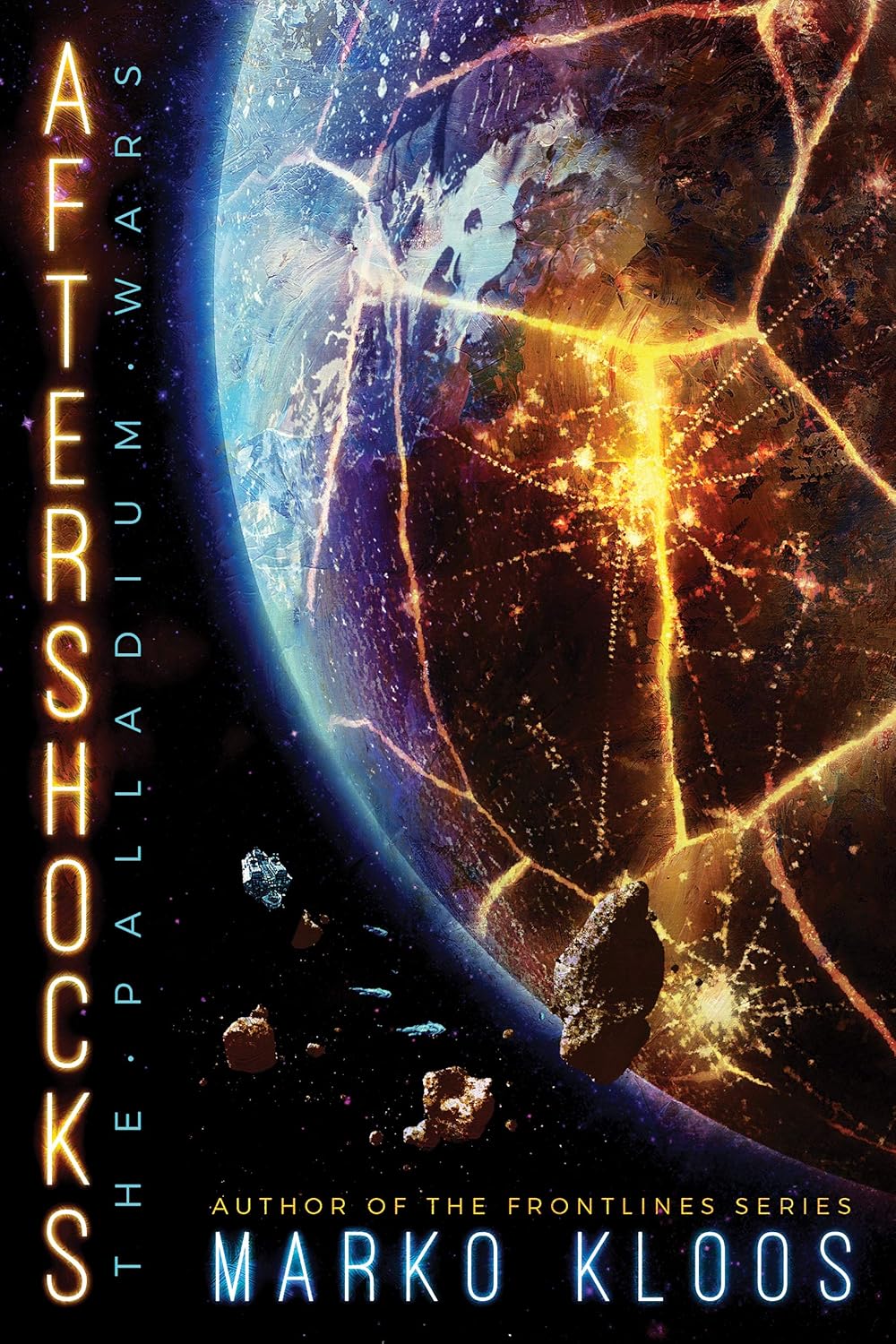
The title Aftershocks says a lot about this novel which opens in a fairly luxurious prisoners of war (POW) residence, where the intransigent Grecians who had waged war against most of the other planets in the system are being housed in a spacious quarters that makes the prisoners believe they are being treated nicely out of spite. Even the blackguards, a particularly detested division of the Grecian military, of which Aden had been an officer, were being housed in this comfy prison.
True to the truce agreement agreed upon by the Grecian government and the victorious alliance, the POWs were to be released in batches after 5 years, and Aden luckily happens to be in the first batch. Aden books a transit on a space cargo transport back to his home planet, hoping that the name change he’d undergone before the war would hide him from his family that he ran away from at the beginning of the war. Incidentally, Aden’s reasons for running from his family would be an important lens on the planetary system and the war, and the author does quite a good job of making Aden’s background story seem as innocuous as anything else being related in this novel. Aden’s cargo ship also get attacked by a rather perfidious pirate ship with some arrival and parting gifts to their victims as they ply their piracy in the constraints of a space system patrolled by militaries that mutually have little tolerance for piracy.
Back on Grecia, Sergeant Idina, a soldier patrolling as part of the alliance troops, gets attacked by very well camouflaged fighters. This leaves all her unit but herself dead. And again on Grecia, there is increasing agitation from the Grecians about their being made to pay huge reparations for starting a war that caused so much destruction in life and property. Meanwhile, Captain Dunstan and his ship on the other side of this multi-planetary world that are guarding a fleet of prized Grecian battle ships is attacked by unknown ships that also blow up the fleet of captured Grecian ships. Captain Dunstan and his ship barely make it out in one piece.
Obviously, there are signs of trouble, though the alliance for the most part don’t seem too ruffled by all this. They respond with their systematic procedures for countering insurgents and pirates. Though, to Idina and Dunstan these attackers seem different, significantly better resourced in key areas than the Grecian military they had just defeated. The only problem is that they can’t put a finger on who could be doing it. Are all these attacks isolated events, or part of some coordinated strategy? That essentially is the question and the plot of the novel, and the world-building and architectural descriptions also add a rich and unique tapestry to the story.
In this mostly terraformed multi-planetary world of humans, there are different shades and languages and physiques of people, seemingly traceable to the unique characteristics of their planet. The author deftly relates the cultural, language and attitude differences among people from the different planets and how it affects their interactions with each other. But of course the Grecians get a special cold shoulder everywhere because of the recent war they’d just waged on the other planets. Architecture is also a strong theme in this novel. The super lofty, enormous enclosed buildings of the Archeroni, the flower petal floating cities of Oceania, the subterranean cities of another planet, space-faring ships plying amongst the orbits the planets traverse, all give a sense of an advanced, sophisticated culture, that is still beset by the stubborn human challenges of thieving, quarreling, and war-fighting. This makes Aftershocks interesting and relatable. The after-war reparations might ring of World War I and the reparations demanded by the Treaty of Versailles.
Overall I enjoyed reading Aftershocks, though I felt that the author was holding back. Aftershocks is skillful writing that handles building and delivering tension well, and provides a pace and visuals that stick. Going forward I’ll think Archeroni any time I think of futuristic lofty buildings playing with geometry and space. However, in these times of many things – books, movies, social media – vying for our limited attention, sometimes authors may have to finesse where they hold back and how and where they deliver the doses of plot-making events, whether in the novel or in its sequel.
 Library books by Shadrack Antwi
Leave a comment