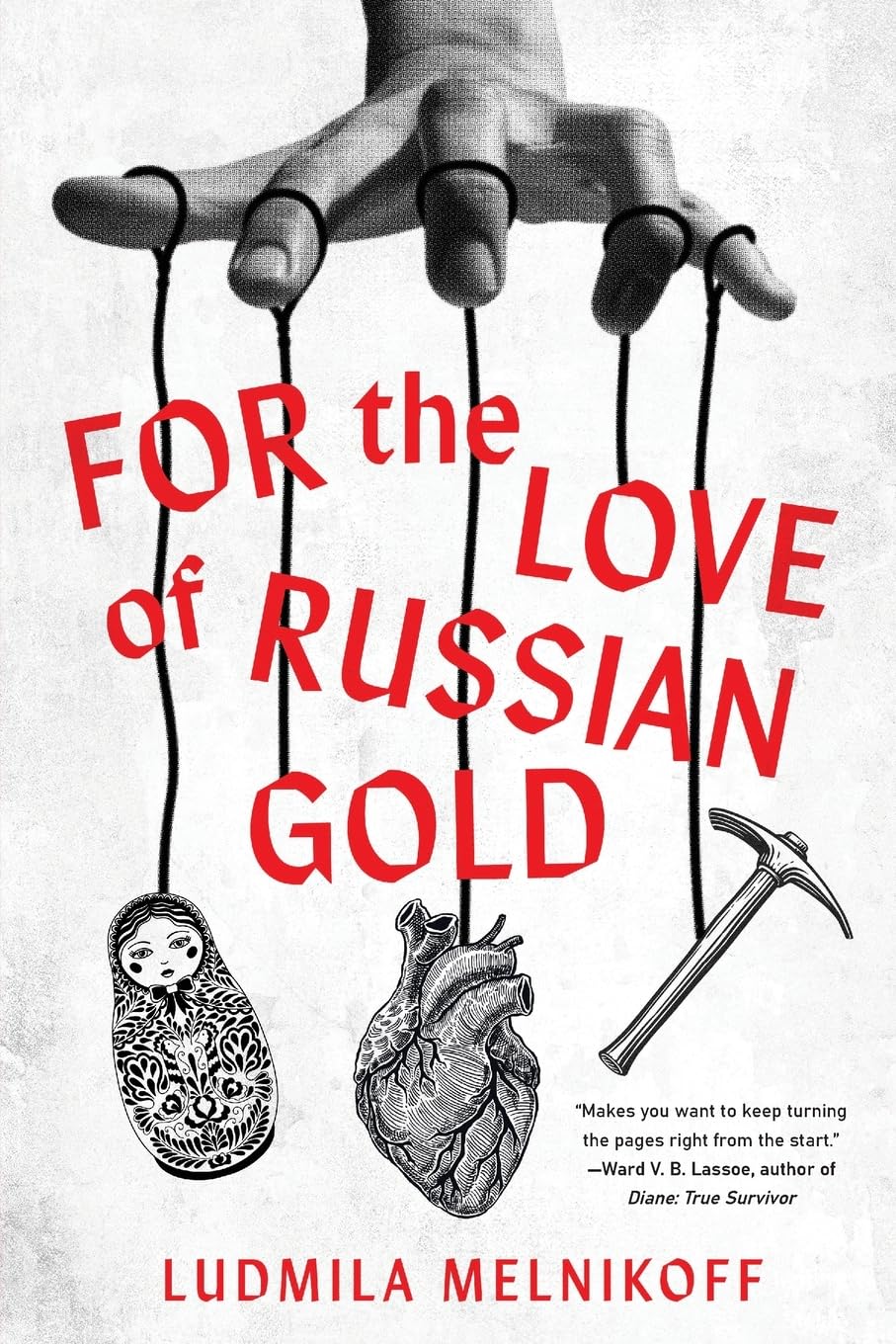
Book Review – For the Love of Russian Gold (by Ludmila Melnikoff)
Many reports, articles, and histories have been written about Russia’s transition from being part of the Soviet Union to its present status as the Russian Federation, from Gorbachev through Yeltsin to Putin. I am by no means a great reader of the histories of the collapse of Communism as we saw it in Russia’s transition from the Soviet Union to the so-called Oligarchic system of present-day Russia under Putin.
In those tumultuous times when communism failed and Russia seemed ready to transition into a market economy that is more in-tune with Western capitalism and many other parts of the world, Ludmila a young Australian woman with Russian ancestry, led a consortium of Australian business men to bid for the mining of a gold deposit in Russian Siberia. Ludmila descends from Russian aristocracy, before Lenin and the Bolshevik revolution caused her family to flee to China and finally to settle in Australia. Born in Australia, growing up in a family that still cherished its Russian origins, Ludmila traveled to Moscow as an exchange student. Despite some unpleasant experiences in Belgrade, where she was transiting and ended up kidnapped by a molester, and overstaying her visa in Russia which got her imprisoned for visa violations and suspicion of being a spy, Ludmila had great experiences in Russia, overall. In any case, years later, despite some misgivings stemming from the negative aspects of her experiences as an exchange student in Russia years back, when her husband Greg piqued her interest in seeking business opportunities in the new Russia emerging from communism, Ludmila warms up to the idea. At this point, she already has a successful lab staffing agency, and she has honed her business and dealmaking skills in Australia. Her ancestry, her command of the language, the time she spent in the country, coupled with her business and deal-making skills, made her arguably the perfect person to bring in viable investors into Russia’s mining industry.
Ludmila signs on with Ian McNee, an Australian businessman with mining businesses all over the world. Ian agrees to fund her business expenses in Russia as part of Star, a business that Ian owns with his Hong Kong partners and other investors. The mine that Ludmila is interested in is Sukhoi Lodge, with reputed sizable gold deposits that was in desperate need of modern equipment and funds to mine.
The Sukhoi mine is an important one for Russia, and to get the license to mine it, you need signatures and permissions that go all the way to the Kremlin, Boris Yeltsin’s office. This is where Ludmila’s ancestry gives her the card needed. Her mum contacts Katya, a famous poet who was close to former presidents of the Soviet Union, with rumors that she had been a lover to one of them as well. Katya is also close to Yeltsin. Katya takes Ludmila to see Yeltsin, and there are photos to prove that they met Yeltsin in person. This is where the love affair with Russia’s gold really begins, as the titular cover of the book says. Yeltsin gives his blessing for Star to invest in Lenzoloto, the Russian company operating the Sukhoi Log mines. But that’s not the end of it; Star has to provide funds and show that it is capable of providing the future funds needed to continually operate the mines. Ludmila and the other functionaries of Star, including Ian, his son Chris, and later Malcolm Turnbull, a future prime minister of Australia, all travel to Bodaibo in Irkutsk Oblast, Siberia, to work with the local government to get all the proper documents signed and for Star to take over the mines. But there are other factions of the Russian government who are less than enthused about Sukhoi Log going to a foreign company, and you may need an index card to keep track of all the officials who are needed to sign a document or give the deal their go-ahead. Moreover, Star itself and Ian must be investigated to satisfy the Russian government, including the KGB, that Star is a legitimate business that has the funds to undertake the Sukhoi Log operations, such as paying workers, and investing in the necessary mining equipment. Also, this is the time of the rise of the Russian Oligarchs, and so there are other players behind the scenes who would rather have the Sukhoi Log Mine for themselves.
The entire process of acquiring the mining rights for Star then unfolds: it’s a murky business with layers of Russian officials who need to look into the deal, and bribes to pay, and funds to prove and deposit. Can Ludmila’s connections to Katya and Yeltsin save the deal for Star as Russian officials demand more proof of Stars funds, and the threat of opening up the mine for open bidding hangs over the deal? It’s a rollercoaster ride smoothed by lots of good food and liquor, and the plain old art of making deals among passionate people from both Russia, Australia and other countries.
With all the passion and the deals done over hearty, close-quarters dinners and alcohol, it is no wonder that Ludmila finds herself in a love relationship with Ian, while her admiration for Malcolm is also ever-present. The relationship with Ian is complicated, because Ian is married with sons Chris, who works with Star and Ludmila, and Argus, who is in boarding school. Ian insists to Ludmila that his relationship with Bobby his current wife is over, and that he will divorce her and marry Ludmila.
For Ludmila, cementing the Star-Lenzoloto deal, while navigating the uncertain relationship with Ian, keeps both the personal and business intertwined. That also makes for an engaging, tense reading. The reader gets as good as an insider view of the Russian government in those days of post-Soviet Russian history; the chaos, and the surprising openness and opaqueness of Russia that seems to promise much gold for those who can go the whole mile.
This is a great read. I have looked up some of the records to do my own small fact-checking, this being a non-fiction. The stories about Malcolm Turnbull’s mercurial temper and emotions checks out. There are also photos in the book to support the narratives, and news articles on the internet that collaborate Ian McNee and Star’s involvement in the Sukhoi Log mines. Ludmila does a good job as a narrator. Of course, the narratives are colored by her own lens, such as her relationship with Ian which doesn’t seem to jump out as a problematic affair until later on. The reader is treated to a first person account of making a complicated business deal in a complicated country, and working with jet-setting investors whose layers of businesses and finances sprawl the globe with intentional privacy or opacity, depending on how you look at it. The reader is also exposed to the casual sexism that women working in such male-dominated fields have to deal with. But Ludmila holds her own, and she is there at the end of it all to tell the stories, and to offer insights about the fate of the deal. This is a fun an engrossing read for anyone who is interested in stories from real scenarios of Russian spies, officials, and the political climate of a nation with one foot in communism while stepping into capitalism. The human stories, though, will probably stay with the reader the most, because the stories are personal, and you don’t get histories written in such personal vividness such as Ludmila would describe in these pages the looks of some of the men and women she encounters on this business of Russian gold.


Leave a comment